Research
Research Projects
A Sequential Modeling Approach to Budget Constraint Promotions At Dream Sports
PIs: Dan Rubenstein & Vijay Pappu
About the Project: At Dream Sports, discounts and promotions are generally employed as a user engagement tactic for fostering long-term retention. In the context of Dream Sports, these problems termed as Budget Constrained Promotions (BCP) allocate promotions to users for joining contests based on multiple objectives like longer user retention and lower cost.
We propose a sequential modeling approach to Budget Constrained Promotions (BCP) at Dream Sports. This approach offers several distinct advantages over the CMDP formulation like dynamic budget constraints, modeling the joint distribution of user states, promotions & costs and understanding user behaviors that lead to long-term retention. We believe that this approach can substantially improve the budget allocation process and also lead to defining intervention strategies that guide user behaviors towards long-term retention.
Accelerating Motor Learning and Skills Acquisition in Sports Using Robotics
PI: Sunil Agrawal
About the Project: Motor learning is an emerging and evolving area in sports science. While motor learning and skills acquisition is routinely practiced in the field of neurorehabilitation, i.e., after a brain injury, it is not yet commonly used as a tool to train athletes. The Robotics and Rehabilitation (ROAR) Laboratory at Columbia University researches on how robotics can be used effectively within movement training and performance enhancement of healthy subjects as well as in functional training for those with brain injury.
Rehabilitation robotics consists of programmable sensors and actuators, worn externally on the human body. The robotics is designed to apply external forces on the body segments, or control their motion, in response to sensed motion of the body and physiological signals, such as muscle EMGs, brain EEG, and heart vitals. Robotics is typically designed to improve a specific movement coordination involved in a human function. The human-robot interface is designed to guide the training according to principles of motor learning.
This project will demonstrate the feasibility of motor training using a robotic test-bed for athletic movements. We will use a fully instrumented testbed called RobUST that has a motion capture system, force plates, virtual reality, and various physiological measurement devices.
Dynamic State Dependent Catalog Optimization Approach for Contest Generation
PIs: Vineet Goyal & Will Ma
About the Project: This project aims to study a dynamic state dependent catalog optimization approach that accounts for correlated user preference both across time and products. Our goal is to design an online policy that considers the real-time state of the system to decide on the contest(s) to open within the next minute ideally in an event-triggered manner.
Monitoring Cardiovascular Health in Athletes during Exercise with Ultrasound
PI: Elisa Konofagou
About the Project: Recent innovation in technology to monitor cardiovascular health outside of the clinic, especially in a wearable format, has enabled the development of methods to optimize athletic performance, health, and safety. Pulse Wave Imaging (PWI), developed by Dr. Elisa Konofagou, is a noninvasive, high-frame rate, ultrasound-based technique that quantifies arterial wall mechanics and blood fluid dynamics. PWI has the potential to equip athletes with novel, unique metrics to quantify their cardiovascular health and aid in the optimization of performance and safety. To develop PWI into a tool for sports, we propose investigating PWI in athletes before and after exercise and developing PWI for peripheral arteries to enable future wearable options. In Aim 1, we will perform PWI scans of the carotid artery in healthy controls and soccer athletes before and after exercise. Through classification models, we aim to detect any differences or trends in vascular health between healthy controls and athletes, and identify any relationships between central arterial properties and the presence of sports-induced mild-concussion. For Aim 2, we plan to develop PWI for peripheral arteries, such as the radial artery, to move towards a wearable format of PWI that can be used to monitor arterial parameters during exercise. Once developed, we will conduct a preliminary study to compare the differences in carotid and radial PWI metrics in young, normotensive subjects.
Reinforcement Learning for Dynamic Contest Design and Catalogue Optimization
PI: Shipra Agrawal
About the Project: In this project, we investigate new reinforcement learning (RL) based approaches for dynamically learning catalogs of contests for new matches based on the observed customer responses and contest adoption in past matches. The goal is to maximize long-term metrics such as total participation in terms of number of participants and/or total revenue over all matches in a given time period. We refer to this problem as the dynamic contest design problem. We discuss many unique and interesting challenges presented by this problem that combine elements from dynamic learning and pricing, assortment optimization, strategic consumer behavior, game theory, and information design. This proposal will build upon the PI's considerable experience in each of the above-mentioned domains, along with the team's expertise in reinforcement learning algorithm design and analysis.
User Behavior Modeling via AI-Optimization Integration
PIs: Henry Lam & Vineet Goyal
About the Project: In this project, our broad goal is to build models that are flexible enough to conform with historical user behaviors, and entails strong predictive power that can be integrated into optimization arising from personalized recommendations and longer-run engagement and revenue maximization. The main approach we propose to undertake is a data-driven optimization by integrating predictive models trained from historical data trajectories of all customers and assimilation into downstream decision-making optimization. One particular behavioral phenomenon that we aim to explicitly capture in our models is related to peak experience. This phenomenon captures a user experiencing a peak from a single win in some contest that results in a long sustained period of engagement even in face of continuous losses.
PhD Fellowships
Juan Nathaniel
Juan Nathaniel is a PhD student in the Department of Earth and Environmental Engineering, in the lab of Prof. Pierre Gentine. He received his B.S. in Environmental Science from the National University of Singapore. He is interested in hybrid machine learning approaches to efficiently learn, distill, and characterize invariant physical processes of complex climate dynamics from sparse and incomplete observations.
Saeyoung Rho
Saeyoung Rho is a PhD candidate at Columbia University, Department of Computer Science. Her research focuses on designing tools to facilitate causal inference. She is also concerned about the privacy and fairness of machine learning algorithms and their impact on the real world.
Research Areas
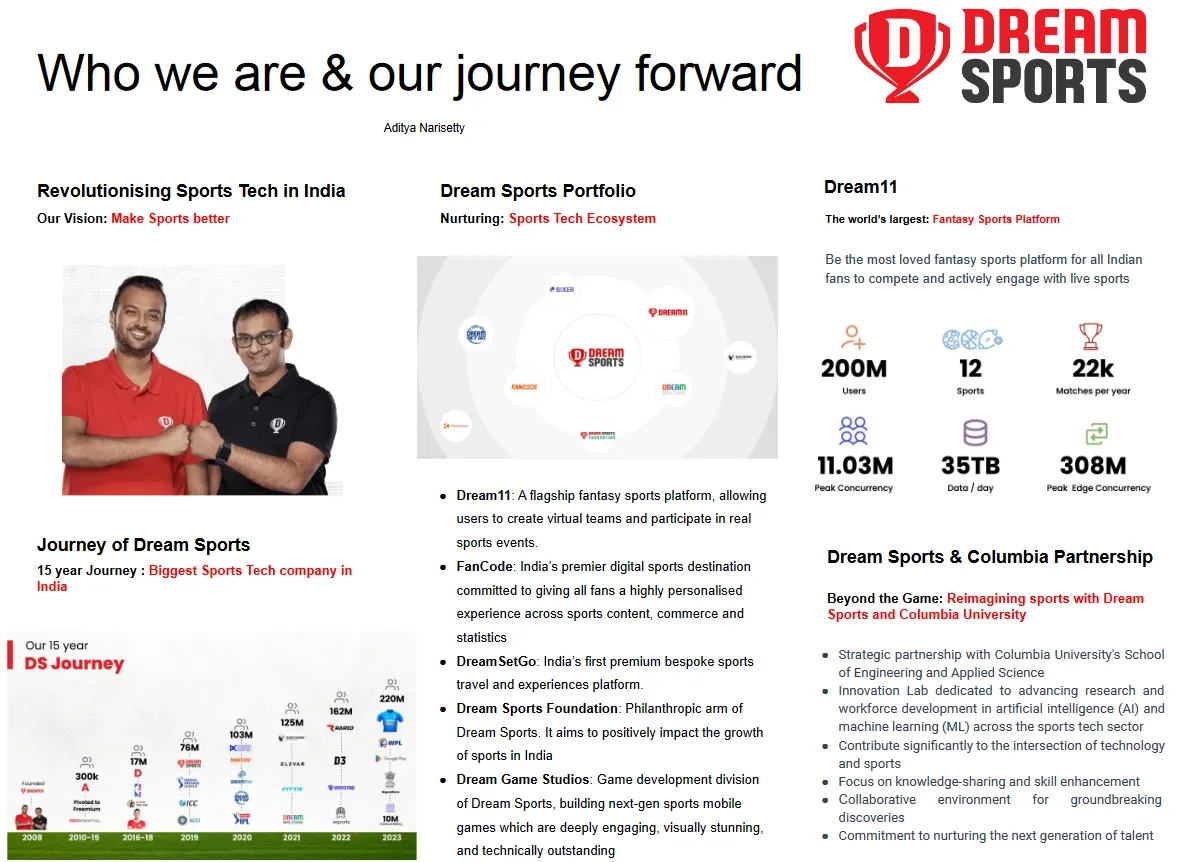
Learn about how Dream Sports has revolutionized sports in India, and how they're working with Columbia University to advance research.
Learn about how Dream Sports uses applied ML and System Simulators to optimize products and predict demand.
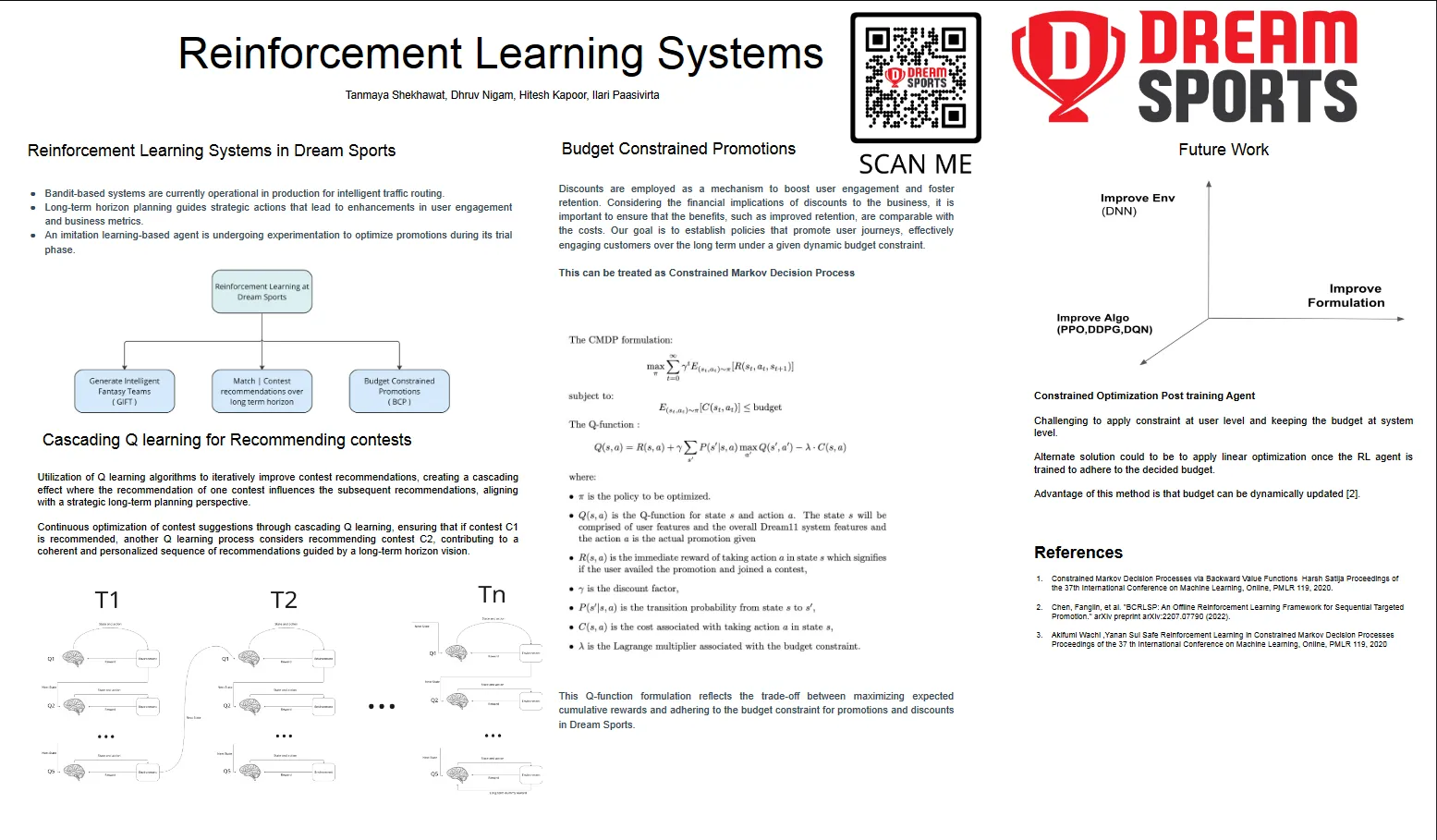
Dream Sports uses reinforcement learning to recommend content and improve user engagement.
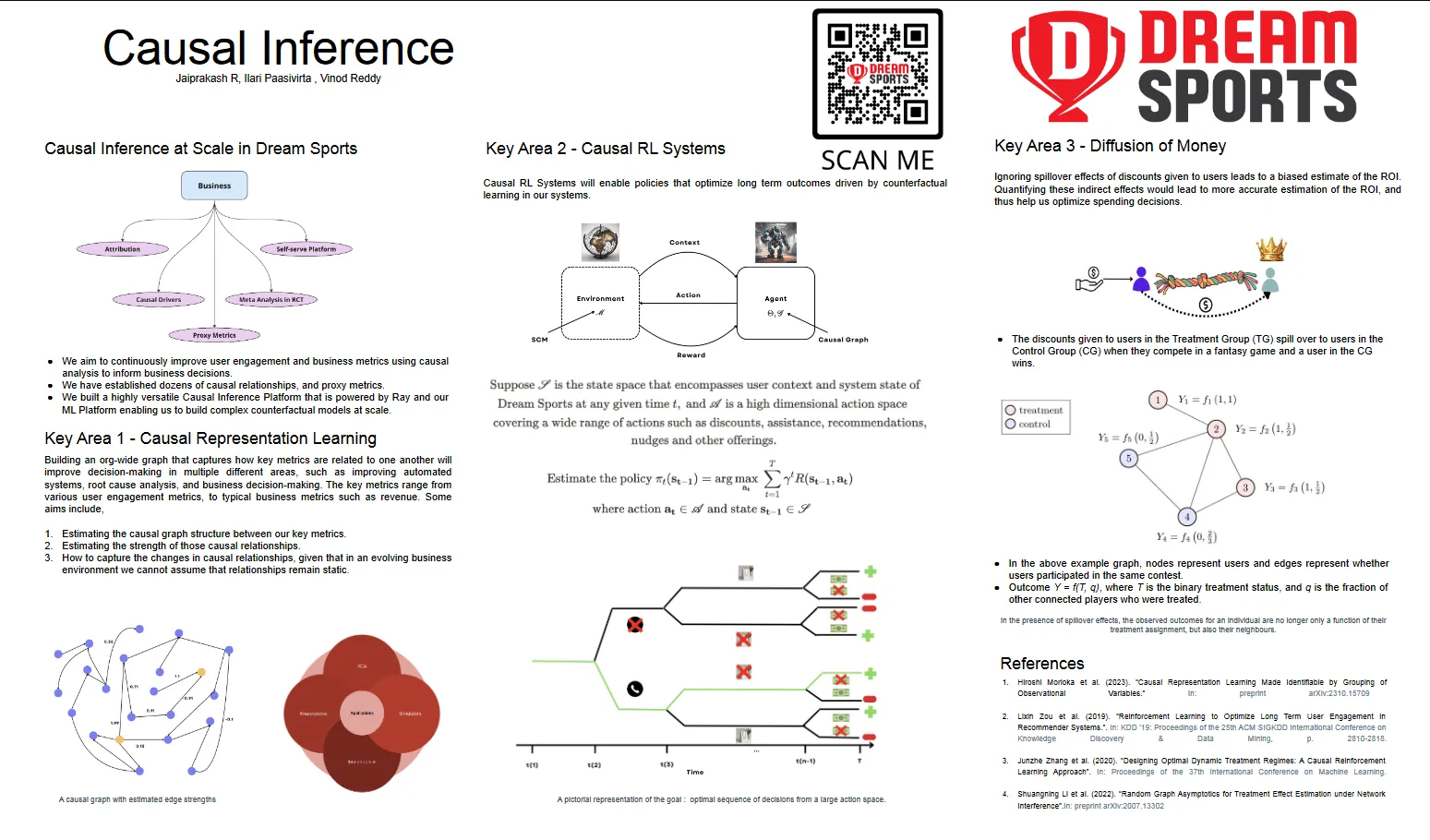
Dream Sports uses causal inference to improve decision-making and allocate resources for its online games.